
Workout Regime
Welcome to the world of fitness! Where there are more training regimes than there are stars in the night sky. You could spend hours scrolling through social media, reading articles, and watching videos, trying to figure out which one is right for you. But do not worry, you are not alone. We have all been there.
The below is a great workout regime that has been proven to be effective. It is not to claim that it is the best program, nor that it is the only option of this sorts. It is simply to say that if you follow it over an extended period of time, you will get in good shape. It is one way to do it. If you are unsure what to try, or have tried different programs over the years and have not seen results. Then, try this.
It is based on a program by Dorian Yates, who won the Mr. Olympia title six consecutive times from 1992 to 1997 . Yates is widely considered to be one of the top pro bodybuilders in history, and was well known for his high intensity training, top-level conditioning, and his wide, thick back.
The regime is suitable for both men and women.
High Intensity Training
This program is in the category of High Intensity Training (HIT) programs. This means that there are relatively few sets, some warm-up sets and few working sets (where you lift what feels heavy to you, this is what makes your muscles grow), and there are short breaks between sets (~ 1 min) and between exercises (~ 1-3 min). The intensity of the program also elevates your heart rate which adds a cardio dimension to the program as well.
Remember to always lift strong and confidently on the positive part of the exercise (when the main muscle(s) is contracting – concentric phase), and slowly and steadily on the negative part of the exercise (when the main muscle(s) is extending – eccentric phase). Squeeze at the top of the exercise and hold for about 1-2 sec, this will increase time under tension and the output of each repetition. As a mental image, imagine that your muscle is a spring coil, and as you slowly take the weight down you load energy in the spring coil, and as you go up you release this energy. Inhale as you take the weight down, and exhale as you lift the weight up.
Always maintain mental focus on which muscle you are exercising, as this will strengthen then mind-to-muscle connection. Make sure to squeeze at the peak for full effect of the exercise.
Four-split
The program is a four-split, meaning there are four different training days in the program, until it restarts. During these four days you will have exercised the main muscle groups throughout your body (not all muscles in the body).
Unless stated otherwise, one set is 8-12 repetitions in which you can maintain perfect form. Form in this context means performing the exercise in a way that maximizes muscle activation and minimizes the risk of injury e.g. by maintaining a neutral spine, using full range of motion and controlling the weight (moving it smoothly and deliberately). For all exercises do 3 working sets, as heavy as you can go doing 8-12 reps. Once you can do 3 sets of 11-12 reps, increase the weight by ~2 kg (if applicable, on each side).
If you do not progress by adding more weights as outlined above, you will just maintain your strength (just spinning your wheels, going nowhere). Keep in mind that muscle growth is the body’s adaptation to stress. If you do not stress the muscle enough, it will not grow.
This four-split allows just enough rest for each muscle group to recuperate.
Looking for tips on workout apparel, check out:
Workout Apparel to Consider for Better and More Enjoyable Gym Sessions
Day 1: Chest & Biceps (~ 1 hour)
Chest Exercises (~ 35-40 min)
- Exercise #1: Injury Prevention
Injury prevention infra shoulder exercise using a dumbbell. As opposed to what is seen in the animated gif above, have one shoulder resting on top of a bench, at incline level 2. Exercise one shoulder at a time. Control the weight by slowly and carefully lowering your arm until it is parallel to the floor (or slightly above). Then lift it up until it is 90° degrees from the floor, while your elbow is resting on the top of the bench. Have your other hand close by, in case you need to support the arm that is being exercised (to ensure a controlled movement). Your feet should be in a position in which you kneel with one knee in the floor (the knee closest to the bench), and one knee 90° degrees towards the floor. Once you can do 3 sets of 11-12 reps, increase the weight by ~1 kg.
Targets the infraspinatus and to some degree the rest of the rotator cuff muscles.
- Exercise #2: Incline Bench-Press
Incline bench-press using dumbbells, holding weights at an angle to avoid unnecessary and harmful stress on your shoulder joint. Incline on bench at level 3. 2 warm-up sets, 3 working sets, 1 drop set.
Targets primarily upper chest, specifically the clavicular head of the pectoralis major. The incline bench press also activates the anterior deltoids (red section in image). The incline bench press can also activate the lower chest and the triceps brachii, but to a lesser extent. (The angle of the bench in the incline bench press determines how much the upper chest and anterior deltoids are activated. A higher angle will put more emphasis on the upper chest, while a lower angle will put more emphasis on the anterior deltoids). - Exercise #3: Cable flies lying on bench
Cable flies on bench at incline level 1 (just above horizontal, much lower incline than in the gif-animation in the link above), set plugs in position no. 2 in the towers at each side. Using fat grip handles is preferred, for more muscle activation, if available. 3 working sets.
Targets primarily mid section of the chest, specifically the pectoralis major, which is the largest muscle in the chest. The cable fly also activates the pectoralis minor, and to some degree the triceps brachii. - Exercise #4: Reverse Cable Crossover
Cable crossover on horizontal bench. Set plugs in position no. 17 in the towers at each side. Using fat grip handles is preferred, for more muscle activation, if available. 3 working sets.
Targets primarily mid (pectoralis major) and lower section of the chest, with some activation of the upper chest. It also activates the posterior (back) deltoids (blue section in image).

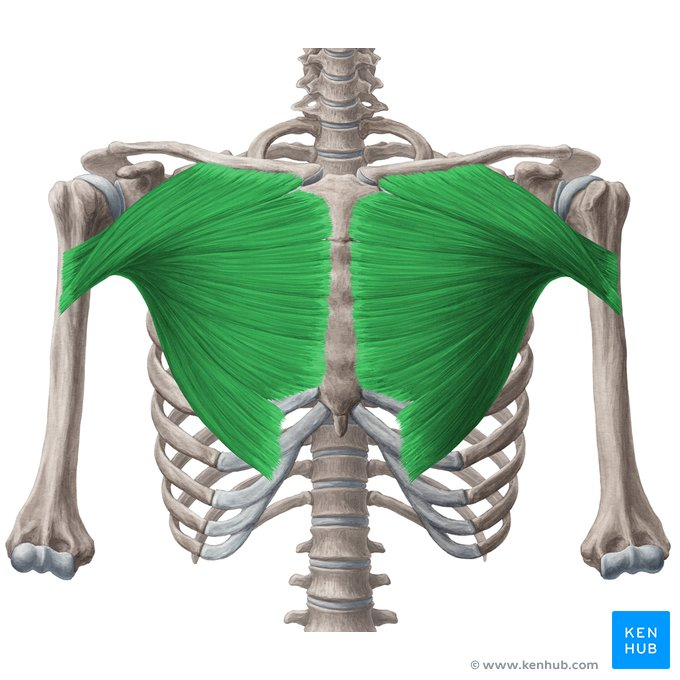
[video coming soon]
Biceps Exercises (~ 20-25 min)
- Exercise #1: Hammer Curls
Stand on an elevated platform (step bench). Use ropes and set the plug in position no.1 in the tower. Hold your shoulders back throughout the exercise. Do hammer curls (neutral grip, see below image). 1 warm up set, 3 working sets. If you need a breather during, keep holding the weights, and then go back at it to complete the set.
Targets primarily activation of the long head of the biceps brachii (red section in image), the outer head of the biceps muscle. The neutral grip used in hammer curls is more effective at activating the long head of the biceps brachii because it allows for a greater range of motion at the elbow joint, which allows the long head of the biceps brachii to work harder. The short head of the biceps brachii (green section in image) is also activated during hammer curls, but to a lesser extent. Hammer curls also activate the brachialis and the brachioradialis. - Exercise #2: Pronated Curls
Standing on the elevated platform, with the ropes, in the same setup, change to a pronated grip (see below image) on the ropes and do 3 working sets. If you need a breather during, keep holding the weights, and then go back at it to complete the set.
Targets primarily activation of the brachioradialis. The pronated grip is more effective at activating the brachioradialis because it requires the brachioradialis to work harder to supinate the forearm. The long head and short head of the biceps brachii are also activated during pronated curls, but to a lesser extent. Pronated curls also activate the forearm flexors.

- Exercise #3: Seated Curls
Incline bench at ~ 45 degrees. Start with weights in a hammer position (neutral grip), rotate to palms up (supinated grip) as you lift the weights to knee height. 3 working sets.
The first part of the exercise targets the same muscles as the hammer curls. The 2nd part targets primarily activate the long head of the biceps brachii (red section in the image). The short head of the biceps brachii (green section in the image) is also activated during supinated curls, but to a lesser extent. Supinated curls also activate the brachialis and the brachioradialis.
[video coming soon]
Day 2: Back (~ 1 hour)
Do the following exercises in a circuit, 1 set then switching to 1 set of the next exercise, etc. for high intensity and limited/no rest.
- Exercise #1: Pull-ups
3 working sets.
Targets primarily activation of latissimus dorsi, biceps brachii, trapezius, rhomboids, infraspinatus and the posterior (back) deltoids (blue section in image). The brachialis and brachioradialis take the role of secondary mover muscles or stabilizers, while the core musculature, forearms and erector spinae are all used as stabilizing muscles as well. Contributes to “width” of the lats.
- If you struggle use assisted “elevator platform“.
- Once you can do 1-2 repetitions lifting your body weight unassisted, then stop using the “elevator platform” and use only your body weight.
- When it becomes to easy with body weight alone, use chain belt with 2.5 kg for all sets. Then, progress with 2.5 kg at a time for all sets.
- Exercise #2: Wide lat pull-down
Lat pull-down, wide bar, pronated grip. 2 working sets.
Recommended exercise by Jay Cutler, who is four-time Mr. Olympia winner (2006, 2007, 2009 and 2010), and six-time runner-up, the most in history.
Targets primarily activation of latissimus dorsi, and also activates teres major. It can also activate the rhomboids. - Exercise #3: Yates row
Yates row with barbell, with pronated grip. 3 working sets.
Targets primarily activation of latissimus dorsi, trapezius muscle group and rhomboids, while the posterior (back) deltoids (blue section in picture) and biceps brachii take the role of secondary mover muscles or stabilizers.

[video coming soon]
Do the following exercises in a circuit, 1 set then switching to 1 set of the next exercise, etc. for high intensity and limited/no rest.
- Exercise #4: T-bar row
T-bar with close grips handle on the bar. 3 working sets.
Targets primarily latissimus dorsi, also activates the teres major and the rhomboids. The close grip on the bar helps to focus the exercise on the lats, as it allows for a greater range of motion and more activation of the latissimus dorsi. Other muscles that are somewhat activated are biceps brachii, trapezius and erector spinae. Contributes to “thickness” of the lats. - Exercise #5: Close lat pull-down
Close grip lat pull-down with a neutral grip handle. 3 working sets.
Targets primarily activation of latissimus dorsi. The neutral grip on the bar helps to focus the exercise on the lats, as it allows for a greater range of motion and more activation of the latissimus dorsi. Other muscles that are activated biceps brachii, trapezius and erector spinae. - (If available, pullover machine. 3 working sets.)
(Targets primarily latissimus dorsi, also activates the teres major and the rhomboids. The angle of the pullover machine can affect which muscles are activated the most. A high angle will put more emphasis on latissimus dorsi, while a low angle will put more emphasis on the teres major and rhomboids.) - Exercise #6: Back extension
3 working sets.
Targets primarily activation of the lower back muscles, hamstrings and gluteus maximus, also activating stabilizer muscle groups like the erector spinae and obliques being activated in an isometric capacity throughout the exercise.
- When it becomes too easy using your own body weight, hold onto a 2.5 kg plate (keeping close to your upper chest with both hands) while doing the back extension for all sets. Then, progress with 2.5 kg at a time for all sets.
- When reaching ~10-15 kg plates, switch to doing back extension using a barbell (at a squat tower instead) and with 30kg weights keeping your legs bent and stable, only using your back to lift the weights. Then, progress with 2.5 kg on each side, per time for all sets. Targets erector spinae, gluteus maximus, hip adductors and core musculature.
- Exercise #7: Plate Shrugs (or Dumbbell Shrugs)
Hold a light weight plate in each hand, with straight arms, and lift your shoulders towards your ears, hold it at the top for 2 sec, and then lower them slowly. This is one rep. 3 working sets.
This isolation movement targets the trapezius muscles. Contributes towards developing what is sometimes referred to as the “Ox neck“.
- When it becomes too easy, progress with 2.5 kg on each side, per time for all sets.
- When it becomes too easy, progress with 2.5 kg on each side, per time for all sets.
[video coming soon]
Day 3: Shoulders & Triceps (~ 55-60 min)
Shoulders (~ 30 min)
- Exercise #1: Lying rear delt row
Lie on your stomach on an incline bench (~ 25-30 degree angle), with a dumbbell each hand, pronated/overhand grip, weights horizontal. 3 working sets.
Targets posterior (back) deltoids (blue section in image). - Exercise #2: One-arm cable lateral raise
Lateral raise with handle, in tower with plug in position no. 1. One shoulder at a time. Hold onto the tower with your other arm, while leaning outwards from the tower. Lift the weight using the handle, by holding your lifting arm behind your back. Lift up until the handle is in line with your shoulders (do not go higher). Do one set for one shoulder, then switch to the other shoulder. 3 working sets (on each shoulder).
Targets lateral (side) deltoids (green section in image). - Exercise #3: Arnold Press
Sit on bench with highest elevation. Do Arnold Presses with dumbbells (hold one dumbbell in each hand, so that your knuckles are facing outwards. Then as you lift the weights above your head, rotate your hands so that your knuckles are facing inwards in the end). 3 working sets.
Targets anterior (front) deltoids (red section in image).
[video coming soon]
Triceps (~ 20 min)
Do the following exercises in a circuit, 1 set then switching to 1 set of the next exercise, etc. for high intensity and limited/no rest.
- Exercise #1: Seated French press with cable
Sit on a bench with incline at the 2nd-3rd highest point. Place next to a tower with the plug attached to point no. 1. Use ropes, lock your elbows, elbows slightly pointing outwards, lift the ropes above your head as you extend your arms. 3 working sets.
Targets primarily activation of the long head of the triceps brachii (red section in image). The long head is the largest and strongest of the three heads of the triceps. It can also activate the lateral head (yellow section in image) and medial head (green section in image) of the triceps brachii, but to a lesser extent. The angle of the cable attachment can affect which head of the triceps is activated the most. A high angle will put more emphasis on the long head, while a low angle will put more emphasis on the lateral head and medial head. - Exercise #2: One-arm triceps pushdown
Use a handle at the other end of the tower (fat grip handle is preferred, for more muscle activation, if available). Put the plug in position no. 15, 16 or 17 (depending on how tall you are). Do triceps pushdowns with one arm at a time. Support a tiny bit with the other arm, if/when required towards the end of a set. 3 working sets.
Targets primarily activation of the lateral head (yellow section in image) of the triceps brachii.
- An alternative is to use the rope for the triceps pushdown, which will make the exercise even more time efficient (rather than doing one arm at a time). When using the rope, squeeze the rope slightly to the side at the bottom of the exercise, by slightly twisting your wrist inwards. 3 working sets.
- An alternative is to use the rope for the triceps pushdown, which will make the exercise even more time efficient (rather than doing one arm at a time). When using the rope, squeeze the rope slightly to the side at the bottom of the exercise, by slightly twisting your wrist inwards. 3 working sets.
- Exercise #3: Reverse grip cable pushdown
Use a flat bar (fat grip handle is preferred, for more muscle activation, if available). Keep the plug in position no. 15, 16 or 17 (depending on how tall you are). The reverse grip cable pushdown requires the most force from the medial head of the triceps as it is done using a reverse grip (supinated forearms) while the elbows are kept to the side of the individual’s body. All movement should be done only by the elbows, preventing any compensation by other parts of the body. 3 working sets.
Targets primarily activation of the medial head (green section in image) of the triceps brachii.
[video coming soon]
Mid-Section Option (~ 10 min)
- Exercise #1: Toes-to-bar leg raises
You can add toes-to-bar leg raises to further strengthen your stomach at the end of the this day, as this day is fairly short. Consider also tucking your legs, and rotating your legs to the sides for strengthening side muscles of the stomach. This will further help you build your mid-section.
- If the above is too challenging, you can use a GHD-Situp bench (often used in Crossfit settings). To progress (and make it heavier), hold a weight plate in your hands.
- Consider also sitting on the top of the GHD-Situp bench and lifting the weight plate from side-to-side for strengthening side muscles of the stomach.
[video coming soon]
Day 4: Legs (~ 1 hour)
- Exercise #1: Barbell Squats
Bend your knees and lower your body until your thighs are horizontal to the ground. 2 warm-up sets (considerably more weights in the 2nd warm-up set). 3 working sets.
The barbell squat is a compound exercise that works multiple muscle groups in the lower body. The primary muscles activated are quadriceps femoris (quads), hamstrings, gluteus maximus (glutes), erector spinae, calves.
- Mix up the routine every now and then by doing sled pushes instead.
- Mix up the routine every now and then by doing lounges (with a dumbbell in your hand) instead.
- Exercise #2: Barbell Deadlifts
Alternate grips (one hand pronated, one supinated) for better grip. Do opposite alternation for each set to avoid too much strain on one bicep over time (very important injury prevention approach to get into your routine early, as it gets really important when you start lifting heavy later on). 2 warm-up sets (considerably more weights in the 2nd warm-up set). 3 working sets.
The barbell deadlift is a compound exercise that works multiple muscle groups in the lower body. The primary muscles activated are hamstrings, gluteus maximus (glutes) and lower back. Other muscles that are somewhat activated are quadriceps femoris (quads), erector spinae and latissimus dorsi (lats)
- Mix up the routine every now and then by doing sled pulls instead.
- Mix up the routine every now and then by doing sled pulls instead.
[video coming soon]
Do the following exercises in a circuit, 1 set then switching to 1 set of the next exercise, etc. for high intensity and limited/no rest.
- Exercise #3: Seated leg extension (machine).
Alternate each repetition stretching out your toes (away from your chest) towards the end of the extension, and pointing your toes towards your chest. Squeeze at the top of the full extension, and hold for 1-2 sec. 3 working sets.
The seated leg extension is an isolation exercise which targets primarily quadriceps femoris (quads). - Exercise #4: Lying leg curls (machine).
Curl your legs until they are roughly vertical, hold for 1-2 sec, then go slowly down. 3 working sets.
The lying leg curl is an isolation exercise which targets primarily the hamstrings.
Do the following exercises in a circuit, 1 set then switching to 1 set of the next exercise, etc. for high intensity and limited/no rest.
- Exercise #5: Seated calf-raises (machine)
Use a leg-press machine. Place your foot ~ half-way onto the plate. Raise your toes first half-way, then down, then all the way up, then down. This is one repetition. 3 working sets.
Targets primarily activation of gastrocnemius. - Exercise #6: Seated calf-raises with full range of motion (machine)
Use a seated calf-raise machine. The key difference from exercise 5, is to place your heal below the horizontal position, with your toes pointing upwards your (your feet in a dorsiflexed position). Go down slowly for each repetition. 3 working sets.
Targets primarily activation of soleus.
- Alternatively, do standing calf-raises (but starting in a dorsiflexed position), which allows for a greater range of motion and more activation of the soleus muscle.
- Alternatively, do standing calf-raises (but starting in a dorsiflexed position), which allows for a greater range of motion and more activation of the soleus muscle.
[video coming soon]
Restart the program. Do the program as often as your time schedule allows. Ideally working out 4-7 days pr. week.
Looking for tips on nutrition, check out:
Healthy and Tasty Meals to Consider for More Optimized Nutrition
Looking for tips on how to boost your performance during exercise, check out:
How Chilling Your Hands Between Sets When Exercising Can Boost Performance
Have sleep, nutrition and exercise already optimized,
and looking to elevate your testosterone to adequate levels, check out:
The Best Supplements to Boost Your Testosterone
Term Explanation: Drop Set
A drop set is a resistance training technique in which you perform a set of repetitions to muscle failure, then immediately reduce the weight and perform another set to muscle failure, and so on. This technique can help you to overload your muscles and stimulate muscle growth.
Once you reach muscle failure, immediately reduce the weight by 10-20% and perform another set of 8-12 repetitions to muscle failure. You can continue to drop the weight and perform additional sets until you can no longer complete 8-12 repetitions.
Drop sets can be done with any exercise, but they are most commonly used for compound exercises that work multiple muscle groups. Some examples of compound exercises that are well-suited for drop sets include squats, deadlifts, bench presses, and rows.
Leave a Reply