
Image Source: Wikipedia
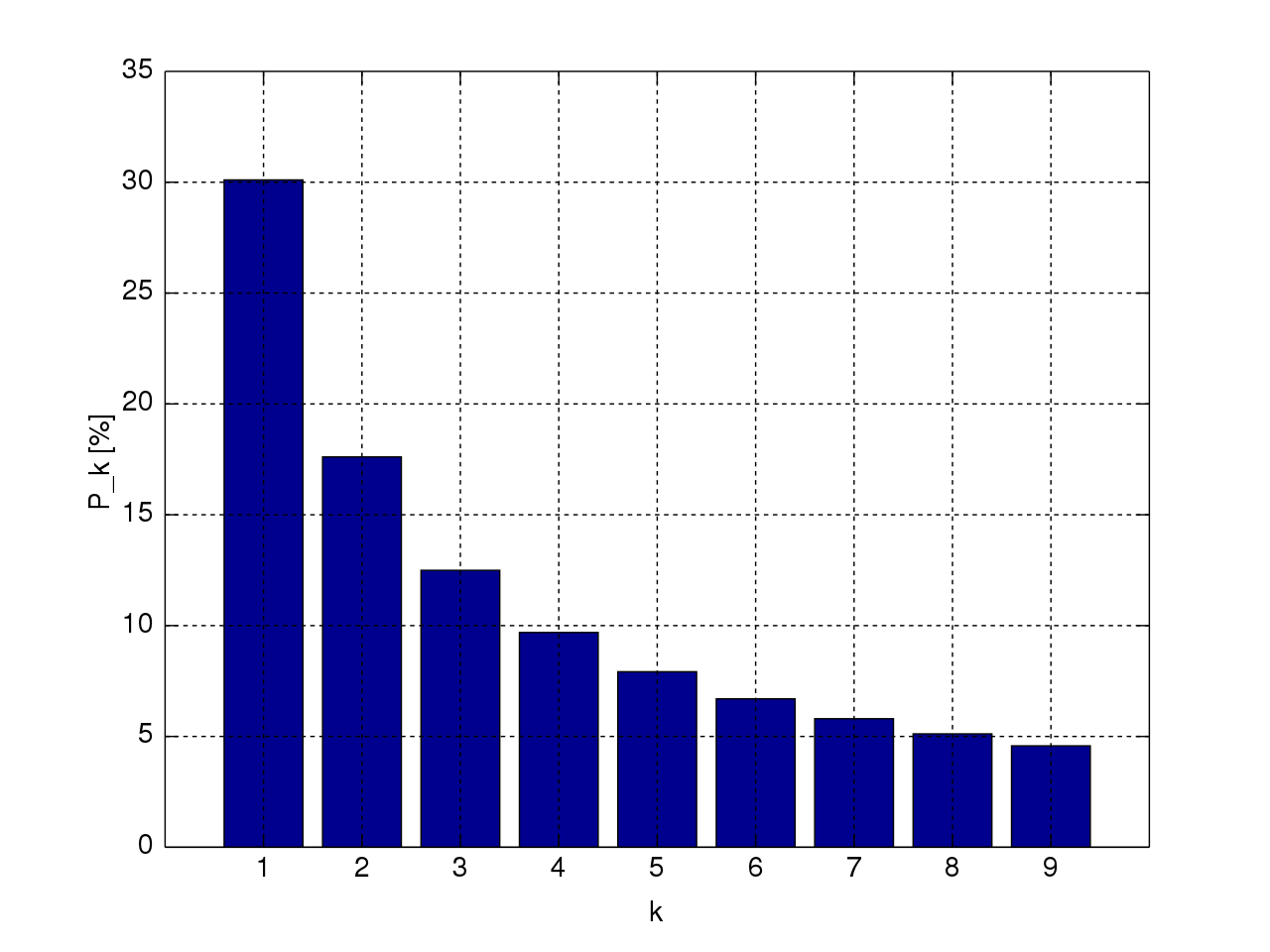
Benford’s Law, also called the law of anomalous numbers, is a probability distribution which states that the first digit of a number drawn randomly from a large and varied population is likely to be 1, followed by 2, 3, and so on. The probability of each digit decreases as the digit value increases.
The law was first published by American physicist Frank Benford in 1938. Benford was studying the distribution of numbers in logarithm tables, and he noticed that the first digit of the numbers was not evenly distributed. He found that the probability of a number starting with 1 was about 30%, while the probability of a number starting with 9 was only about 4%.
Benford’s Law has been applied to a wide variety of data sets, including population counts, financial data, and scientific measurements. It has been used to detect fraud, identify data entry errors, and uncover patterns in nature.
A Few Examples
- Business and Fraud Detection
Benford’s Law has been used by businesses to improve their financial reporting, risk management, and marketing campaigns. For example, it has been used to identify customers who are at risk of defaulting on loans and fraudulent financial statements. For financial statements this can be picked up for instance by noticing in a review that the first digit of the company’s revenue numbers is always 1. This is suspicious, because the probability of this happening by chance is very low. The most likely explanation is that the company is falsifying its financial statements. - Data analysis
Benford’s Law can be used to identify data entry errors by comparing the distribution of first digits in a data set to the expected distribution under Benford’s Law. Outliers and anomalies can also be identified by looking for numbers that have first digits that are significantly different from the expected distribution. - Natural phenomena
It has been applied to a variety of natural phenomena by looking at the distribution of first digits in data sets that describe these phenomena. For example, the distribution of river lengths has been found to follow Benford’s Law, which suggests that the process of river formation is random. - Engineering
Benford’s Law has been used to improve the accuracy of engineering models and simulations by using it to calibrate the models. For example, it has been used to calibrate a model of the Earth’s atmosphere.
Benford’s Law is a powerful tool that can be used to detect fraud and uncover patterns in data. It is a valuable tool for scientists, analysts, and anyone else who works with data.
Keep in Mind
- The law applies to any set of data that is collected randomly and independently. This includes data sets of all sizes, from small to large.
- The law is not perfect. There are some data sets that do not follow Benford’s Law. However, the law is a good starting point for detecting fraud and identifying data entry errors.
- Benford’s Law is not a substitute for other statistical methods. It is a tool that can be used in conjunction with other methods to improve the accuracy of your analysis.
Leave a Reply